
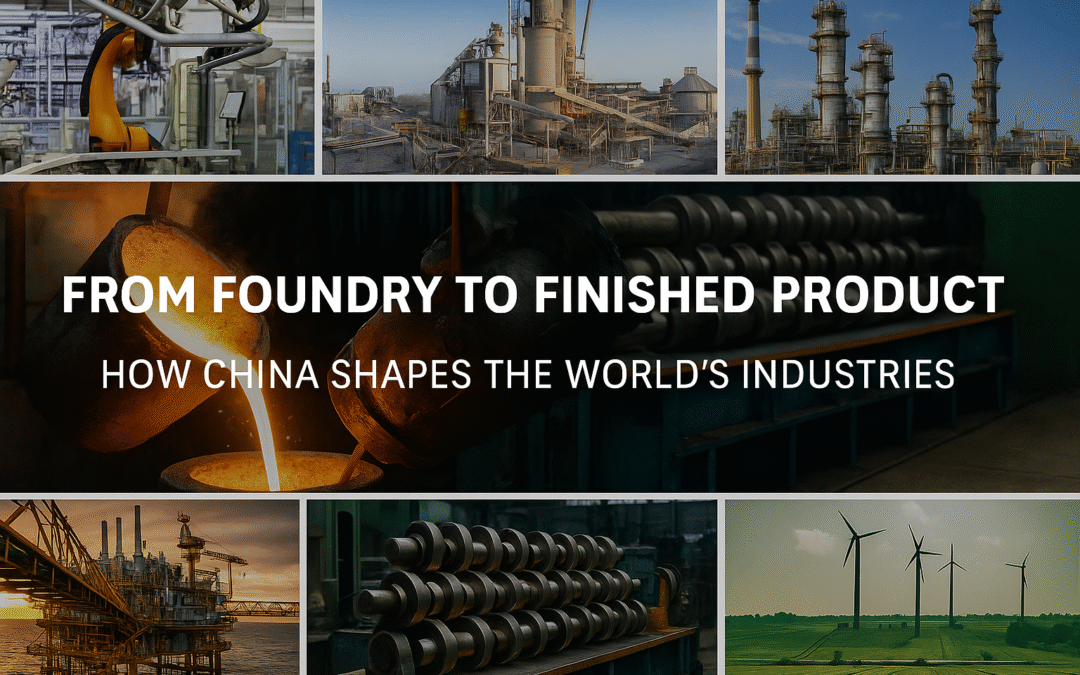
China’s rise as the “world’s factory” is no accident — it is the result of decades of industrial planning, investment in infrastructure, skilled manpower, and technological advancement. From the fiery foundries producing molten steel to precision-engineered parts shipped worldwide, China’s manufacturing ecosystem is unmatched in scale and efficiency. This vast network supports industries ranging from steel and cement to pharmaceuticals and high-tech electronics, powering economies across the globe.
1. The Backbone of Global Manufacturing
China’s industrial dominance begins in the foundries — massive facilities where raw materials are transformed into essential components. Steel production alone accounts for more than half of the world’s output, with Chinese mills supplying everything from rebar for construction to specialized alloy steel for automotive and aerospace applications.
The scale is staggering: fully automated rolling mills, state-of-the-art casting machines, and extensive logistics hubs ensure that products move from plant to port with remarkable speed.
2. Cement and Infrastructure Giants
Cement is the silent hero of global infrastructure, and China is its largest producer by a wide margin. The same highways, bridges, and skyscrapers shaping the skylines of Asia, Africa, and Latin America often rely on Chinese cement exports.
Advanced rotary kilns, energy-efficient grinding mills, and precision quality control have enabled Chinese cement plants to supply consistent material for projects ranging from local housing developments to mega infrastructure ventures like ports and railways.
3. Refinery and Petrochemical Powerhouse
China’s refinery sector not only meets its domestic demand for fuels and chemicals but also serves as a crucial supplier to other industrial economies. Modern refineries in regions like Guangdong and Shandong are integrated with petrochemical complexes that produce polymers, synthetic rubbers, and industrial lubricants.
These materials are indispensable in manufacturing — from automotive tires to electronics casings — creating a supply chain loop where China both produces and consumes at massive scales.
4. The Growing Pharmaceutical Hub
In recent years, China has emerged as a global leader in pharmaceutical production, supplying active pharmaceutical ingredients (APIs) and finished medicines to markets worldwide. High-tech laboratories and GMP-compliant manufacturing facilities ensure strict quality control, meeting the stringent requirements of the US FDA and European EMA.
This capability became especially visible during the COVID-19 pandemic when China rapidly scaled up production of critical drugs, PPE, and medical equipment for global distribution.
5. Foundry-to-Finished Excellence
The journey from molten metal in a foundry to a finished industrial product is a story of efficiency and integration. For example, in the steel sector:
- Melting & Casting – Scrap or raw iron ore is melted, refined, and cast into billets or slabs.
- Forming & Machining – The semi-finished products are rolled, forged, or machined into precision parts.
- Finishing & Testing – Coatings, surface treatments, and rigorous inspections ensure durability.
- Distribution & Export – Dedicated ports, rail networks, and shipping fleets connect Chinese manufacturers to every continent.
6. Technology and Automation
China’s advantage no longer rests on low labor costs alone. Modern factories deploy robotic arms, AI-driven quality control, and advanced CNC machinery. This shift has elevated product precision, reduced defects, and improved production timelines.
In heavy industries like forging and casting, computer simulations optimize mold design before production even begins, reducing waste and ensuring perfect tolerances.
7. Global Partnerships and Trade
Chinese industrial companies maintain partnerships with distributors, traders, and service providers worldwide. Whether it’s supplying mill rolls to a steel plant in the Middle East, valves to a refinery in Africa, or pharmaceutical ingredients to Europe, the country’s trade network is unparalleled in reach.
Belt and Road Initiative (BRI) projects further cement these relationships, building infrastructure that facilitates long-term supply contracts and economic collaboration.
8. Sustainability in Industry
With growing global attention on climate change, China’s industries are investing in energy efficiency, carbon capture, and renewable energy integration. Steel mills are experimenting with hydrogen-based reduction, cement plants are recycling industrial waste into raw materials, and refineries are introducing cleaner-burning fuels.
This commitment to sustainable practices is essential not only for meeting domestic environmental goals but also for maintaining access to markets with strict environmental standards.
9. The Future — High-Value Manufacturing
China is moving beyond bulk production to focus on high-value, high-tech manufacturing. Sectors like aerospace components, medical devices, advanced robotics, and green energy equipment are expanding rapidly.
This evolution ensures that China’s industrial leadership will remain secure even as global market dynamics shift.
In Summary:
From the heat of the foundry floor to the precision of final assembly, China’s industries are the engine that keeps the global economy running. Its ability to integrate massive production capacity with technological innovation, quality assurance, and global logistics makes it a partner no economy can ignore. As the world faces new challenges and opportunities, China will continue shaping the industrial landscape — one finished product at a time.