
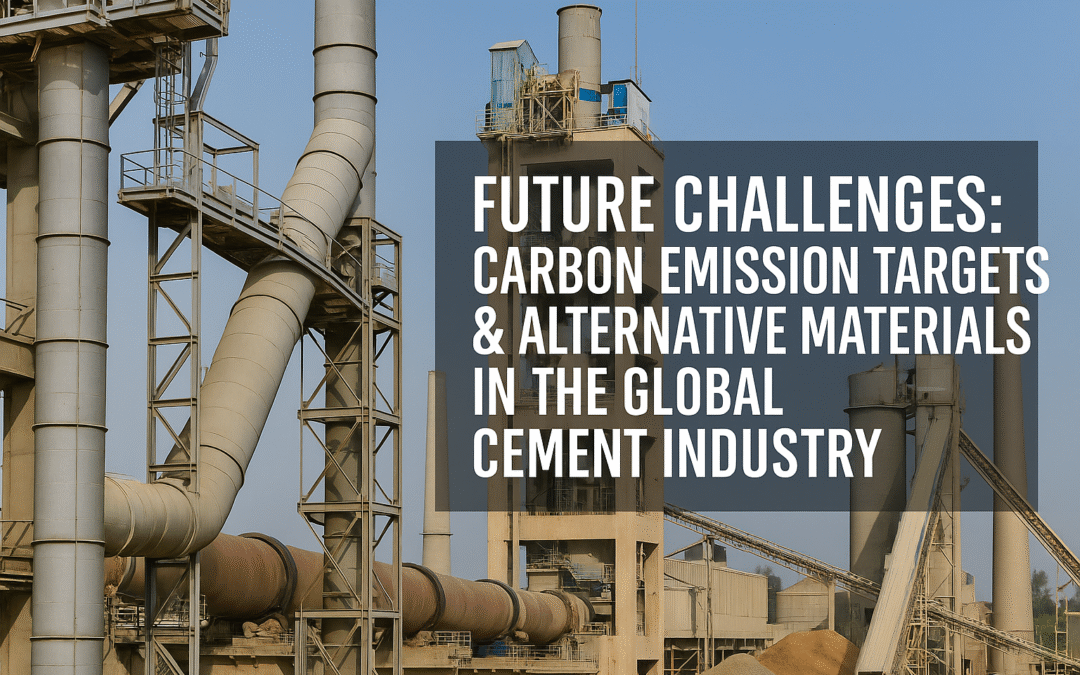
The cement industry is one of the largest contributors to global carbon emissions, responsible for approximately 7–8% of total CO₂ emissions worldwide. As governments tighten environmental regulations and consumers demand greener products, the industry is under unprecedented pressure to decarbonize while still meeting the world’s growing demand for infrastructure.
For countries like China — which accounts for more than 50% of global cement production — the stakes are even higher. Not only is the industry a backbone of economic growth, but it is also a focal point in the nation’s carbon neutrality commitments. This dual role makes the cement sector both a challenge and an opportunity in the global fight against climate change.
Two themes dominate the future of the industry: achieving carbon emission targets and developing viable alternative materials. This article explores these challenges, the technologies under development, and the path forward.
- Understanding the Carbon Footprint of Cement Production
Cement production is inherently carbon-intensive due to two main factors:
- Calcination Process – When limestone (CaCO₃) is heated in a kiln to produce clinker, it releases CO₂ as a byproduct of the chemical reaction. This accounts for about 60–65% of emissions.
- Energy Consumption – The high temperatures (1,400–1,500°C) required in kilns demand significant energy, often from coal or petcoke, contributing the remaining 35–40% of emissions.
Key emission statistics:
- Every ton of cement produces about 0.9 tons of CO₂.
- China produces over 2.1 billion tons of cement annually — translating to ~1.9 billion tons of CO₂.
- Without intervention, cement sector emissions could rise by 20–25% by 2050 due to urbanization.
- Carbon Emission Targets – The Global and Chinese Perspective
2.1 International Commitments
Countries are aligning their industries with the Paris Agreement, aiming to limit global warming to below 1.5°C. For the cement industry, this means reducing CO₂ intensity per ton of cement by 30–50% by 2050.
Notable national commitments:
- European Union: Net-zero by 2050; cement plants subject to strict carbon pricing under the EU Emissions Trading System.
- United States: Significant funding for carbon capture and utilization in cement under the Inflation Reduction Act.
- India: Targeting 33–35% emissions intensity reduction by 2030.
2.2 China’s Carbon Neutrality Pledge
China has pledged to:
- Peak carbon emissions by 2030
- Achieve carbon neutrality by 2060
For cement:
- National policies now limit energy intensity per ton of clinker.
- Provincial governments are piloting low-carbon industrial parks where cement, steel, and power plants share energy and resources.
- Carbon trading pilots are underway, potentially adding financial penalties for high emitters.
- The Path to Meeting Emission Targets
3.1 Process Optimization
- Clinker Factor Reduction: Lowering the proportion of clinker in cement by using supplementary cementitious materials (SCMs) like fly ash, slag, and calcined clay.
- Energy Efficiency Upgrades: Using preheaters, precalciners, and high-efficiency grinding mills can cut energy use by 10–15%.
3.2 Carbon Capture, Utilization, and Storage (CCUS)
CCUS technology captures CO₂ from cement kilns before it enters the atmosphere.
- Post-combustion capture: CO₂ is extracted from flue gases using solvents.
- Oxy-fuel combustion: Burning fuel in pure oxygen increases CO₂ concentration, making capture easier.
- Utilization: Captured CO₂ can be used in curing concrete, producing carbonates, or even synthetic fuels.
Challenges:
High cost, energy penalty, and lack of large-scale infrastructure for CO₂ transport and storage.
3.3 Alternative Fuels
Replacing fossil fuels with:
- Biomass (agricultural waste, wood chips)
- Refuse-Derived Fuel (RDF) from municipal solid waste
- Hydrogen as a long-term solution for high-temperature kilns
Alternative fuels can reduce direct CO₂ emissions and contribute to circular economy practices.
- Alternative Materials – The Next Frontier
4.1 Supplementary Cementitious Materials (SCMs)
SCMs replace a portion of clinker, reducing emissions:
- Fly Ash – Byproduct of coal-fired power plants
- Ground Granulated Blast Furnace Slag (GGBFS) – From steelmaking
- Calcined Clay – Abundant, low-carbon alternative gaining popularity in Asia
- Natural Pozzolans – Volcanic ash, pumice
China’s edge:
Given its massive steel industry, China has access to large quantities of slag, making slag cement a promising low-carbon option.
4.2 Novel Binders
Research is advancing on cement alternatives that bypass the CO₂-heavy clinker production process:
- Geopolymer Cement – Uses industrial byproducts and alkali activators; can cut emissions by up to 80%.
- Magnesium Silicate Cement – Absorbs CO₂ during curing.
- Limestone Calcined Clay Cement (LC³) – Combines calcined clay with limestone for significant clinker reduction.
4.3 Carbon-Negative Materials
Emerging materials aim to store more CO₂ than they emit:
- CarbonCure Concrete – Injects CO₂ during mixing, permanently mineralizing it.
- Bio-concrete – Uses bacteria to precipitate calcium carbonate, potentially absorbing atmospheric CO₂.
- Market & Regulatory Drivers
5.1 Carbon Pricing
- EU’s carbon price exceeds €80/ton, creating strong incentives for low-carbon technologies.
- China’s national carbon market is expanding to heavy industries, including cement.
5.2 Green Procurement Policies
Governments increasingly require low-carbon materials in public projects, driving demand for certified sustainable cement.
5.3 Consumer and Investor Pressure
Large construction firms now publish sustainability reports and require suppliers to meet emission benchmarks.
- Barriers to Change
6.1 Cost
Low-carbon technologies like CCUS and novel binders can increase production costs by 30–50%.
6.2 Technical Constraints
Not all alternative materials match the performance of traditional OPC (Ordinary Portland Cement).
6.3 Supply Chain Issues
Availability of SCMs can vary geographically; some are tied to industries (like coal power) that are themselves shrinking.
- The Road Ahead – Strategic Recommendations
For Producers
- Invest in pilot CCUS plants.
- Diversify fuel mix to include at least 20% alternative fuels by 2030.
- Partner with research institutions for novel binder development.
For Policymakers
- Offer tax incentives for low-carbon cement.
- Fund infrastructure for CO₂ transport and storage.
- Create clear carbon intensity benchmarks.
For Investors
- Support scalable low-carbon solutions.
- Factor carbon pricing risks into project valuations.
Conclusion
The cement industry’s path to a sustainable future is neither quick nor easy. Carbon emission targets will require an unprecedented transformation in technology, operations, and business models. At the same time, the development and adoption of alternative materials offer a once-in-a-century opportunity to reshape one of the world’s oldest industries.
China, as the world’s largest cement producer, holds the key to global progress. By investing in innovation and aligning with global climate goals, the country can not only meet its own carbon neutrality targets but also lead the world in sustainable construction materials.
The next decade will determine whether the cement sector becomes a climate liability or a climate leader. The challenge is immense — but so is the opportunity.