
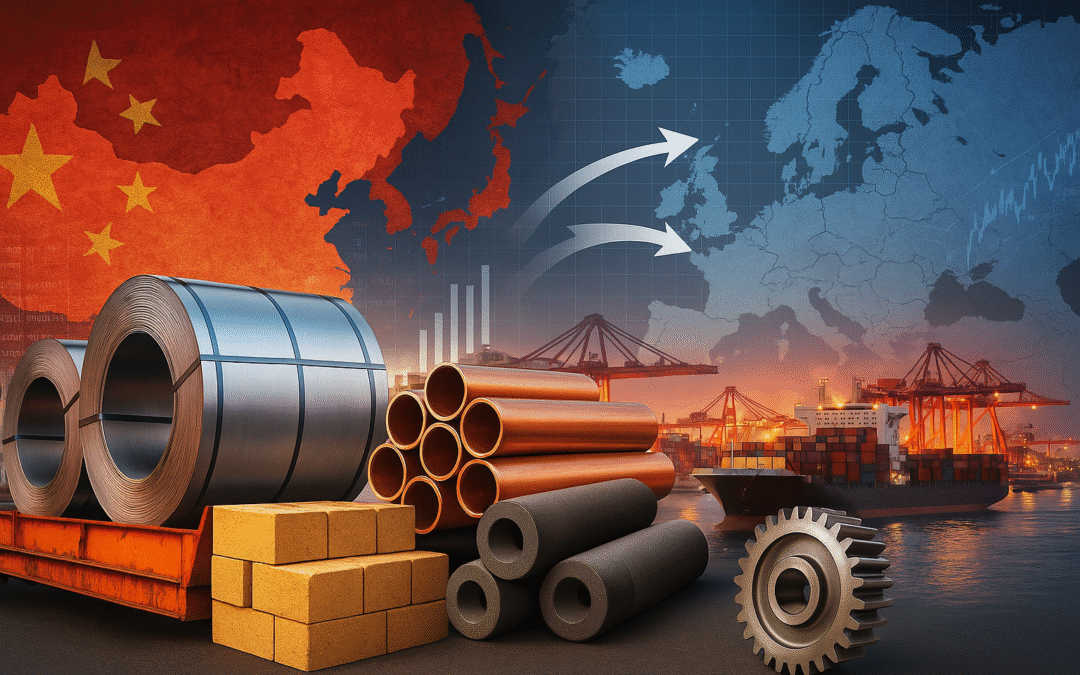
The steel and process industries of Europe are standing at a pivotal crossroads. Over the past decade, global supply chains have undergone a profound transformation, driven by the twin forces of economic efficiency and geopolitical realignments. For European manufacturers, particularly in Central and Eastern Europe, the challenge has been stark: maintain competitiveness in an environment where production costs are soaring due to energy prices, labor costs, and environmental compliance, while still keeping pace with the relentless modernization of industrial infrastructure.
In this shifting landscape, China has emerged as a vital partner. Once seen primarily as a producer of raw steel, China today commands a significant share of the global market in high-value metallurgical products, spare parts, and process equipment. Its industries have scaled up not only in capacity but also in technological sophistication, offering European buyers a combination of cost savings, customization, and reliable supply that is increasingly hard to match within the EU itself.
Consider the numbers: in 2024, the European Union imported over USD 6.5 billion worth of iron, steel, and metallurgical items from China, a figure that has grown steadily year after year. Central Europe — particularly the Czech Republic, Poland, Slovakia, Austria, and Hungary — has been at the forefront of this shift. For example, the Czech Republic alone imported nearly USD 451 million worth of articles of iron and steel from China, ranging from rolling mill rolls and copper mould tubes to gear shafts and refractory products. These are not low-tech commodities but precision-engineered components that keep Europe’s mills, foundries, and process plants running.
Why European Buyers Turn to China
The reasons behind this growing reliance on Chinese supply are complex but compelling:
-
Cost Competitiveness – With energy and labor costs among the highest in the world, European OEMs struggle to deliver competitively priced spares. Chinese manufacturers, benefiting from scale and efficiency, routinely offer price points that are 30–40% lower, without sacrificing durability or performance.
-
Customization Capability – Many Central European mills and plants operate on older equipment platforms. While European OEMs often push for complete system upgrades, Chinese suppliers can adapt and replicate spares for legacy machinery, extending plant lifecycles at a fraction of the cost.
-
Supply Chain Resilience – The pandemic highlighted vulnerabilities in global logistics, but Chinese state-owned manufacturers were among the first to re-establish consistent supply chains to Europe. Today, partnerships with these suppliers provide not just product access but also assurance of continuity.
-
Technological Evolution – China is no longer a follower. Advances in metallurgy, precision forging, and refractory science mean that Chinese factories today produce to EN, ASTM, and ISO standards, with third-party certifications (SGS, BV, TUV) providing buyers with confidence in quality.
The Strategic Shift
For European buyers, particularly purchase managers in steel mills, cement plants, and fertilizer factories, the choice is becoming clear: partner with Chinese suppliers not just as an option, but as a strategic necessity.
Across Europe, purchase managers are asking the same questions: How do we reduce downtime? How do we lower maintenance costs? How do we stay globally competitive without overhauling entire plants? The answer, increasingly, points toward Chinese spare parts and metallurgical solutions.
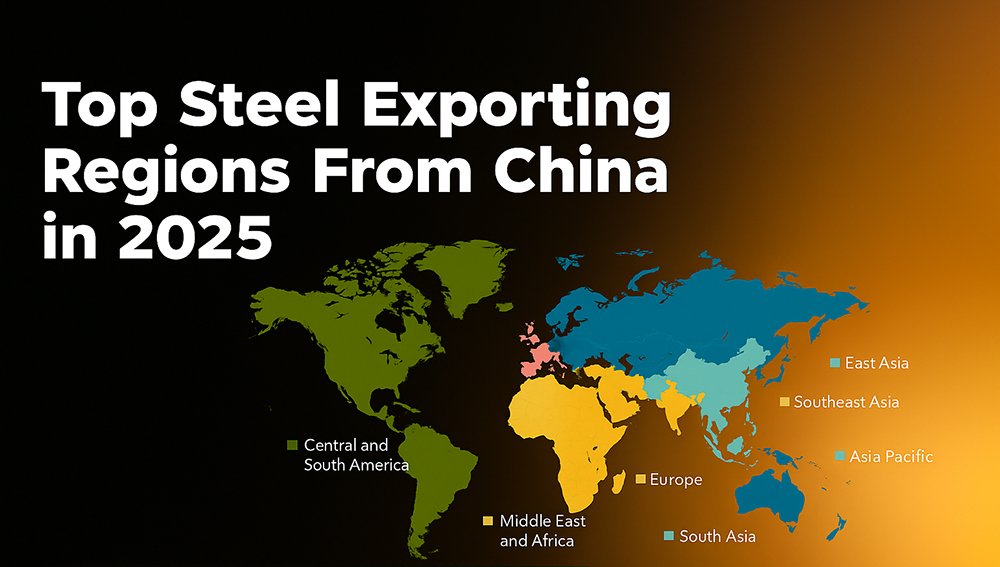
Market Landscape: Steel and Industrial Imports in Central Europe
According to Eurostat and UN Comtrade, imports of iron, steel, and industrial spare parts from China into the EU surpassed USD 6.5 billion in 2024, with Czech Republic alone importing over USD 450 million worth of “articles of iron or steel.”
Table 1: Central European Imports from China (2024, Approx.)
| Country | Import Value (Iron & Steel Products) | Key Imported Items |
|---|---|---|
| Czech Republic | USD 451 million | Rolls, forged parts, tubes, fittings |
| Poland | USD 620 million | Machinery spares, mill rolls, copper moulds |
| Slovakia | USD 280 million | Flat products, electrodes, valves |
| Germany | USD 1.2 billion | Precision spares, forging parts, refractories |
| Austria | USD 190 million | Gear shafts, pipes, fittings |
| Hungary | USD 210 million | Valves, electrodes, forged parts |
Trend
These imports have grown by 12–15% year-on-year, showing Europe’s reliance on Chinese metallurgical supply.
Why European Buyers Look to China
-
Cost Advantage: Chinese manufacturing remains 30–40% cheaper than EU OEMs.
-
Customization: Ability to tailor rolls, gears, and refractory designs to specific mill configurations.
-
Scale & Reliability: Large state-owned plants in China can guarantee bulk supply with consistency.
-
Modernization Drive: Many Central European mills still run older machinery; Chinese spares extend operational life at lower cost.
China’s Strategic Edge in Metallurgical Exports
Unlike small-scale traders who focus only on narrow product categories, leading Chinese suppliers now offer integrated portfolios across steel, cement, fertilizer, power, and refinery industries.
-
State-Owned Partnerships: Direct collaboration with large state-owned factories ensures both capacity and quality.
-
European Reach: Regular export channels already established in Germany, Czech Republic, Slovakia, Poland, and Austria.
-
Comprehensive Portfolio: Rolls, copper mould tubes, graphite electrodes, refractories, gearboxes, and forged mechanical spares.
-
Quality Assurance: Products manufactured under ISO, ASTM, and EN standards — with independent inspections available from agencies like SGS, BV, and TUV.
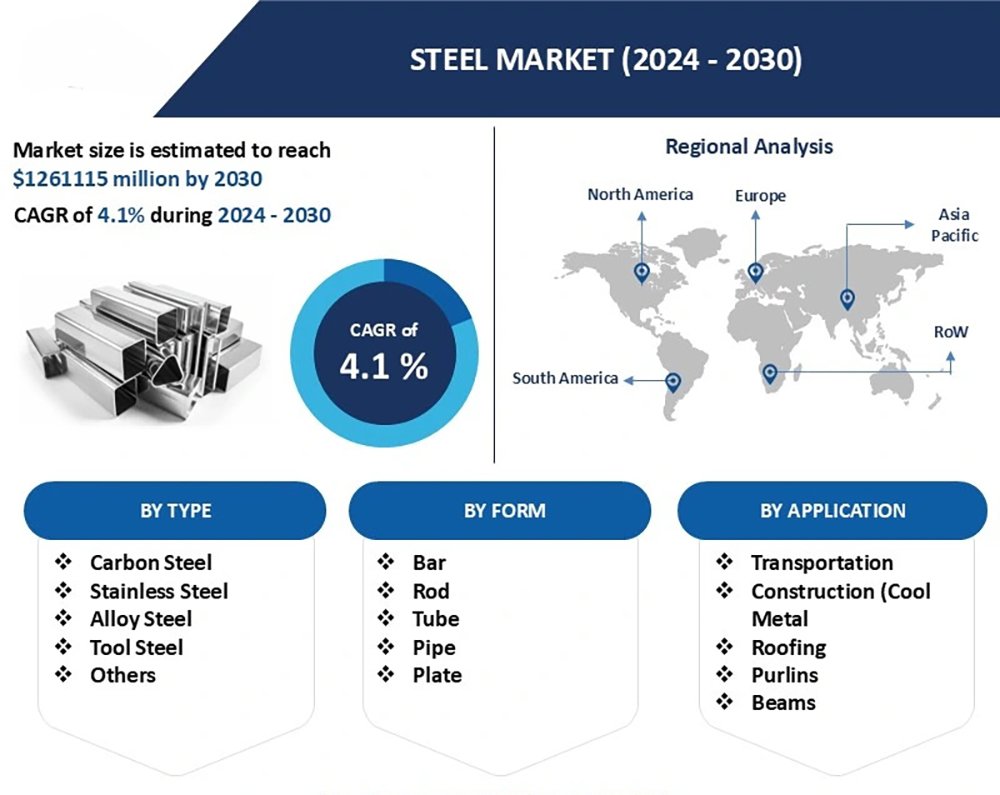
The steel market forecast for 2024–2030 highlights a sector that is set for steady but significant expansion, with the market size projected to reach over USD 1.26 trillion by 2030 at a CAGR of 4.1%. This growth reflects the dual pressure of rising global demand in infrastructure, transportation, and construction, alongside diversification into value-added applications such as roofing and engineered beams. Regionally, demand remains strongest in Asia-Pacific and Europe, though North and South America continue to represent critical growth pockets. Segmentation by type shows the dominance of carbon and stainless steels, while the product mix—bars, rods, tubes, and plates—mirrors the requirements of large-scale industrial projects. The analysis makes clear that steel remains a foundational material for global economic development, with steady regional growth ensuring both volume stability and innovation-driven opportunities across applications.
Key Product Segments for Steel Mills
🔹 Rolling Mill Rolls
Work rolls, backup rolls, and intermediate rolls manufactured from forged steel, designed for extended wear life and precise tolerances.
-
Why European buyers prefer: High-quality heat treatment ensures durability even under extreme loads.
🔹 Copper Mould Tubes
Essential in continuous casting machines, ensuring dimensional accuracy and longer casting cycles.
-
Why important: Longer service life reduces unplanned shutdowns.
🔹 Graphite Electrodes (RP/HP/UHP)
Available from 14 to 32 inches, BSFC supplies electrodes for electric arc furnaces across Europe.
-
Advantage: Strong thermal shock resistance, consistent conductivity, and precision-machined nipples.
🔹 Refractory Products
Bricks, slide gate plates, nozzles, tundish nozzles, and ladle refractories.
-
Advantage: High resistance to thermal cycling and mechanical wear.
🔹 Forged & Machined Parts
Gear shafts, cardan shafts, bearings, dummy bars, couplings — precision-engineered to keep mills running.
Beyond Steel: Multi-Industry Coverage
While steel mills are the backbone, many of BSFC’s products are cross-industry spares also used in:
-
Cement Plants: Kiln tyres, girth gears, grinding rolls.
-
Fertilizer Plants: Granulation drums, coolers, dryers.
-
Power Plants: Boiler tubes, pressure parts, valves.
-
Refineries: High-pressure valves, forged pipes, fittings.
-
Glass Plants: Melting furnace refractories, forming equipment.
Case Snapshot: Czech Republic
Czech steel producers import hundreds of tonnes of rolls, copper mould tubes, and refractory products annually. Many of these come from Chinese suppliers, as local EU OEMs often price 30–50% higher.
👉 BSFC’s position: offering direct-from-China supply routes, bypassing unnecessary intermediaries and giving buyers cost savings plus technical assurance.
Challenges Buyers Face – and Our Solutions
-
Tariffs & Anti-Dumping: BSFC works with compliant sourcing channels and proper documentation.
-
Delivery Lead Time: Strategic logistics hubs ensure shipments via Hamburg, Koper, and Gdańsk ports within 30–40 days.
-
Certification Needs: Products delivered with EN/ASTM test reports and mill certificates.
Conclusion
Europe’s industrial sector is at a crossroads: balancing cost with modernization. With proven capacity, technical expertise, and strong state-owned partnerships, Beijing Sino Forging Company is positioned as the ideal bridge between Europe’s growing demand and China’s metallurgical strength.
📧 Contact: sales@beisinoforge.com | 🌐 Website: www.beisinoforge.com